Rescuevation Shop
pak-ex – The No. 1 Against Carcinogenic PAHs on the Skin
Couldn't load pickup availability
pak-ex – the no. 1 against carcinogenic PAHs on the skin
Strengthen the safety of your crews: pak-ex is a skin cleanser developed specifically to remove polycyclic aromatic hydrocarbons (PAHs) reliably from the skin. It removes more than 96 % of PAHs and measurably lowers the exposure of firefighters.
PAHs form during incomplete combustion in every fire. They are carcinogenic and readily penetrate the skin. Conventional soaps and wet wipes (often containing penetration enhancers) clean insufficiently: in an independent study (Keir et al. 2023), more than 56 % of PAHs remained on the skin after washing with soap and more than 77 % after using wipes, compared with less than 4 % after pak-ex.
pak-ex sets a new standard in decontamination after fire incidents.
Why pak-ex?
- Removes more than 96 % of PAHs from the skin, without penetration enhancers, soaps or degreasing agents.
- Protects the natural skin barrier and reduces the risk of PAH uptake through the skin or secondary oral uptake (cross-contamination).
- Up to 10 times higher cleaning performance than conventional soap products.
- Dermatologically certified “very good” (dermatest®).
- Developed by DermaPurge, a spin-off of the Leibniz Institute of Polymer Research Dresden, with deep fire-service expertise.
Who is pak-ex for?
- Fire departments, civil protection, hazmat and industrial operations
- Chimney sweeps, industrial fire brigades, training facilities
- All fields of operation with PAH exposure
Application after fire incidents
- Apply pak-ex generously to visible soiling.
- Massage in gently to release PAHs from the skin without stressing the skin barrier.
- Rinse thoroughly with cold water (max. 32 °C).
-
Do not forget hands, face, neck, ears, throat, forearms and other exposed skin areas.
Tip: use directly at the incident scene to avoid carrying contamination into the apparatus or the station.
Product details
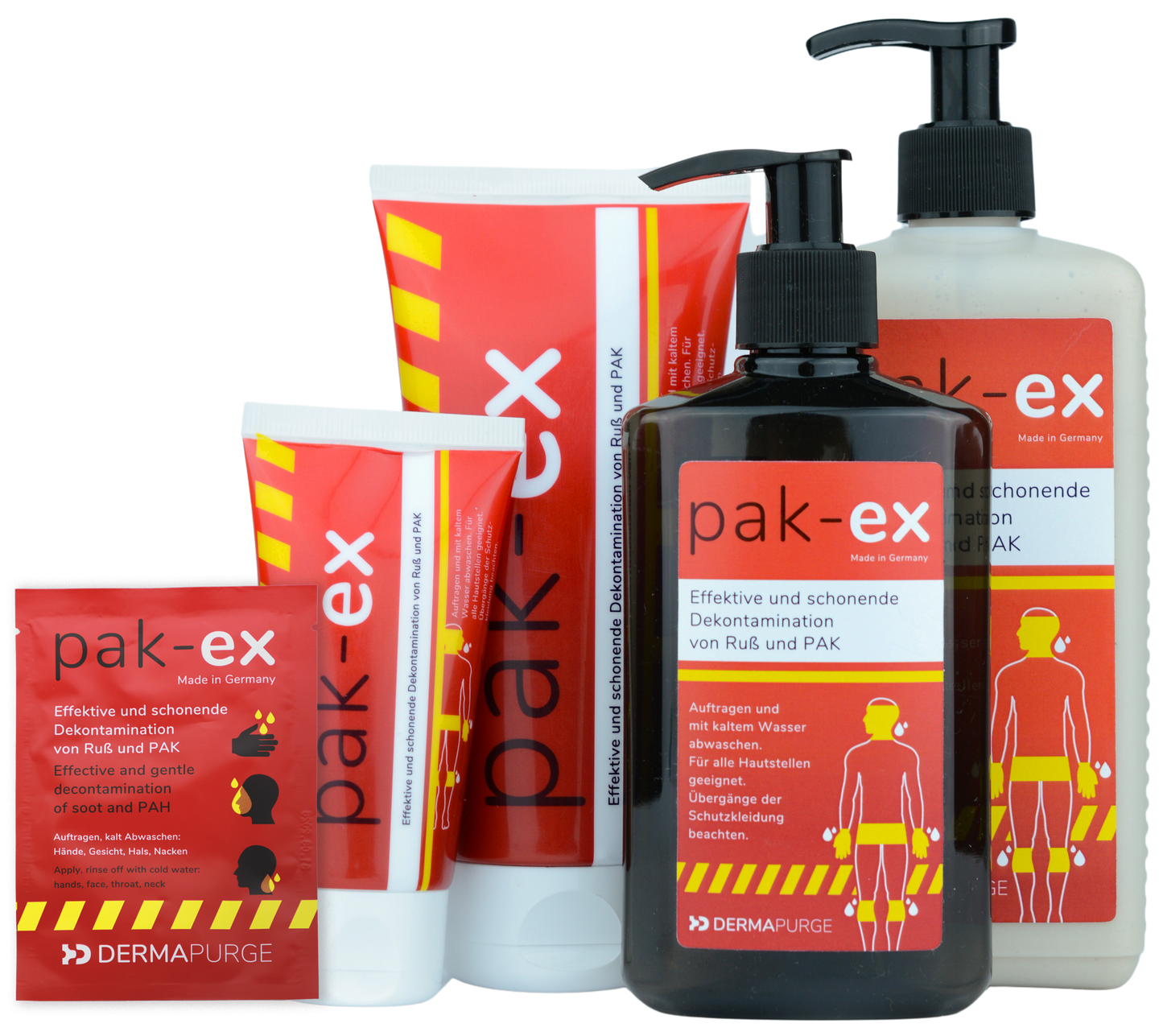
- Container: EURO pump dispenser, 500 ml
- Robust plastic pump, resealable
- Compatible with wall-mounted EURO dispenser systems
- Soap-free, no penetration enhancers, gentle skin formulation
Developed by experts
DermaPurge combines cutting-edge research with operational experience. The team around PhD chemist Dr. Jonas Schubert develops advanced skin cleansing solutions for research, industry, fire departments and civil protection. Managing Director Jonas Schubert is a long-serving volunteer firefighter (including roles as SCBA wearer and crew leader). With pak-ex, DermaPurge supports the FeuerKrebs® initiative to improve health and working conditions for firefighters.
Your benefits at a glance
- Maximum PAH removal to reduce firefighter exposure
- Skin barrier stays intact: no penetration enhancers, no soaps
- Scientifically developed, field-proven, dermatologically certified
- Ready to use in the 500 ml EURO pump dispenser

When are carcinogenic PAHs formed?
PAHs are formed in every fire, but especially during incomplete combustion and when plastics burn.3 Because residential buildings today are particularly well insulated, both the air supply and smoke extraction are significantly reduced, which favors incomplete combustion. The increasing use of plastics in building components and furnishings also means that larger amounts of PAHs are produced in the event of a fire.
Why pak-ex reduces your PAH exposure:
-
No penetration enhancers - 400% safer
The skin-friendly formulation is free of soaps, abrasives, and degreasing components so as not to impair the skin's barrier properties.
-
Removes 96% of PAHs
The pak-ex gel removes at least 96% of PAHs from the skin while remaining as gentle on the skin as possible – thanks to a pH skin-neutral formulation and the absence of penetration enhancers and fragrances.
-
Dermatest: excellent
The independent and renowned dermatological institute Dermatest has tested the skin compatibility of pak-ex and certified it as 'very good'
Cancer among firefighters - a recognized occupational disease
Why are carcinogenic PAHs relevant for firefighters?
Carcinogenic PAHs (polycyclic aromatic hydrocarbons) are formed in every fire, and up to 75% can be absorbed through the skin.
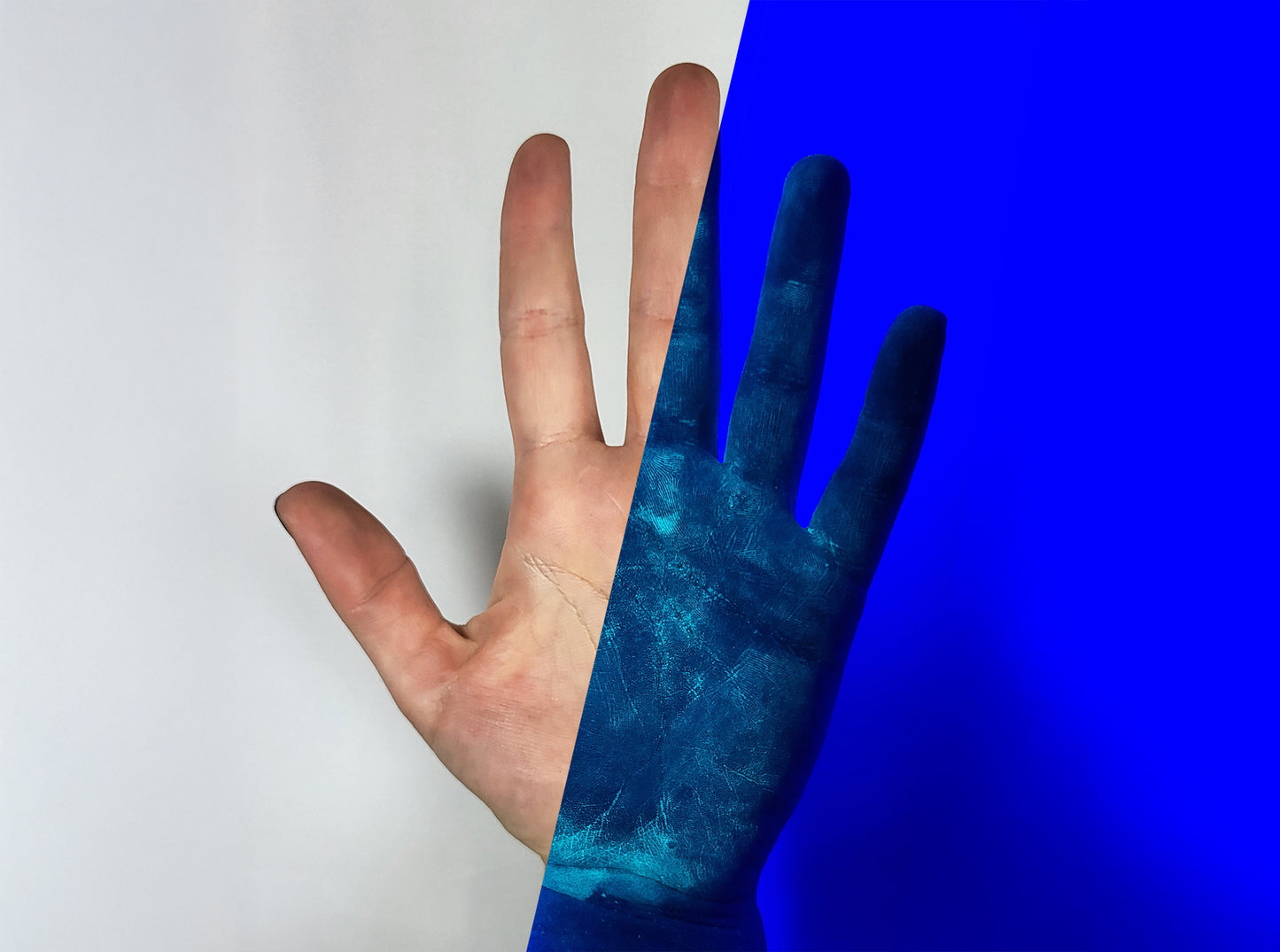
PAHs are not visible – they are not the same as soot.
PAHs are hydrophobic, so they are normally barely soluble in water!
PAH DNA damage through epoxidation
What do PAHs cause?
PAHs cause DNA damage. PAHs are therefore proven to be carcinogenic.
The WHO has classified the occupation of firefighting in the most hazardous category, 1a, "known to be carcinogenic".
For example, the risk of testicular cancer is increased by around 200%. The risk of prostate cancer by 159%, and for bladder cancer even the mortality risk increases by 72%!
How penetration enhancers increase cancer risk
What is the wash-in effect?
With the wash-in effect, so-called penetration enhancers (soaps, surfactants, solvents) open the pores while the skin is being washed, damaging the natural skin barrier. PAHs can then penetrate the skin up to 400% more easily.
The skin-friendly pak-ex formulation is free of soaps and degreasing components so as not to impair the skin's barrier properties.
How big the PAH problem is with conventional cleaning
What percentage of PAHs currently remains on the skin?
According to an independent study, when using wipes – including specially marketed decontamination wipes – more than 77% of carcinogenic PAHs remain on the skin.
With standard soap, more than 56% of PAH residues remain on the skin.
When using pak-ex, less than 4% of carcinogenic PAHs remain on the skin.
How it works: effective PAH removal
How does pak-ex work?
pak-ex uses the clay minerals kaolin and bentonite.
These clay minerals are naturally sourced minerals capable of binding many substances.
The skin-friendly formulation is free of soaps and degreasing components so as not to impair the skin's barrier properties.
pak-ex is pH skin-neutral and thus preserves the skin's natural protective acid mantle.
pak-ex was developed by specialists at the Leibniz Institute of Polymer Research Dresden. The product is patent pending (EP 2 215 7087.2)
The independent dermatological institute Dermatest has tested the skin compatibility of pak-ex and certified it as 'very good'.
Contact form
Which industries is pak-ex for?
-
Fire departments
Firefighters are among the occupational groups that come into contact with PAHs relatively often through their exposure to fire smoke and soot. Good incident hygiene is therefore essential.
-
Track construction
Track construction workers are at risk from PAHs because they frequently work with tar-containing materials such as old railroad ties or ballast binders. These release PAH-containing dust and vapors that settle on the skin. Through heat and sweat, these substances can penetrate the skin and thus increase the risk of cancer.
-
Chimney sweeps
Chimney sweeps are at risk from PAHs because they regularly come into contact with soot and combustion residues. These residues contain high concentrations of PAHs, which settle on the skin and can penetrate the skin through heat and sweat. This increases their risk of cancer, especially in areas that often get dirty or sweaty – such as the neck, nape, and forearms.
FAQ pak-ex
What is pak-ex?
pak-ex is a special skin cleansing product for use after contamination with PAHs (polycyclic aromatic hydrocarbons). PAHs are formed especially during incomplete combustion and can only be removed inadequately with conventional products. Effective cleansing with pak-ex prevents the absorption of PAHs through the skin and subsequent oral intake due to cross-contamination. pak-ex removes more than 96% of PAHs. The skin-friendly formulation is free of soaps, abrasives, and degreasing components so as not to impair the skin's barrier properties.
Is there more information about pak-ex ingredients?
pak-ex was developed on the basis of special, skin-friendly cosmetic raw materials. The pak-ex formulation deliberately avoids substances known as 'penetration enhancers'. When working with hazardous substances, products containing degreasing substances (soaps, surfactants, solvents) should be avoided, as degreasing the skin can lead to increased absorption of hazardous substances. Clay minerals are naturally sourced minerals capable of binding many substances. pak-ex uses the clays kaolin and bentonite. Its particular skin compatibility was confirmed by the independent laboratory Dermatest® and rated 'very good'.
What is the consistency of pak-ex?
Beige, unscented, paste-like suspension
How are PAHs formed?
PAH stands for the chemical compounds "polycyclic aromatic hydrocarbons".
PAHs are formed during combustion – they are found together with soot and fire smoke, but also, for example, in crude oil, tar products, and legacy contamination in the construction industry.
PAHs are carcinogenic and responsible for an increased risk of skin, laryngeal, and bladder cancer, among others. Because they are absorbed through the skin, they enter the body directly via skin contact. This absorption is further increased by heavy sweating or contact with soaps.
Are PAHs visible to the human eye?
PAHs are not visible to the human eye. The danger they pose is therefore often underestimated.
Incorrect skin cleansing in particular carries the risk of PAHs remaining unnoticed on the skin.
Which occupational groups are affected by PAHs?
Firefighters are among the occupational groups that come into contact with PAHs relatively often through their exposure to fire smoke and soot. Good incident hygiene is therefore essential.
However, many other occupational groups also deal with PAHs in their daily work. These include chimney sweeps, fire damage restorers, and employees in coking plants, thermal power stations, and foundries. In the construction industry, for example in track and road construction, contact with tar products – and thus PAHs – can also occur. If you belong to one of these occupational groups or are unsure whether you are affected, contact us directly!
How does pak-ex work?
pak-ex contains no soap or abrasives, which would attack the skin and make it more permeable to hazardous substances.
Instead, the skin cleansing gel consists mainly of natural clay minerals whose physico-chemical properties create an environment on the skin that attracts PAHs and soot like a magnet. They can then simply be washed off the skin.
Does pak-ex replace the complete skin protection plan?
No. pak-ex is used where there is contact with fire residues, fire smoke, tar, and crude oil. It replaces soap and other skin cleansers in the skin protection plan only in these areas. For hygiene purposes, the skin should still be cleaned/disinfected with soap or disinfectant after using the toilet and at the start of a shift. If pak-ex and soap are to be used together, pak-ex should always be applied before the soap to avoid washing hazardous substances into the skin.
A protective cream before work and/or a care cream after work can still be used regardless of the use of pak-ex.
What are penetration enhancers?
Our skin protects us from external environmental influences. Factors such as sweat, very warm water, or skin injuries can already impair the skin's protective barrier and lead to increased absorption of hazardous substances. Scientific studies have also identified a number of substances that act as so-called 'penetration enhancers'. These are substances that particularly limit the natural skin barrier's ability to perform its protective function. In medicine, this principle is used, for example, to facilitate the absorption of active pharmaceutical ingredients through the skin. Many skin care products also contain penetration enhancers to keep the skin soft and smooth. When in contact with hazardous substances such as PAHs, the use of penetration enhancers is problematic and therefore not recommended. The right choice of skin cleansing products without penetration enhancers is crucial!
Which penetration enhancers are known?
Soap impairs the skin barrier – many people know that. But what else? Since we are often asked, we have started compiling a list of scientifically documented penetration enhancers.
The list is not complete – but it is a start and is intended to help you make the right choice for skin cleansing after fire operations based on sound scientific evidence.
Alcohol denat [1], Aloe Barbadensis extract [10], Caprylic/Capric Triglyceride [8], Cetylpyridiniumchlorid [13], Chamomilla Recutita Extract [9], Citric Acid [6], Cocamidopropyl Betaine [4], Coco Glucoside [3], Disodium Cocoyl glutamate [7], Glycerin [1], Isopropyl Alcohol [1], Lactic Acid [5], Limonene [12], Linalol [12], PEG-40 Hydrogenated Castor Oil [2], Polysorbat 20 [14], Propylene Glycol [1], Sodium Cocyl Glutamate [7], Sodium Lauryl Sulfate (soap) [13], Vitamin E [11].
[1] Williams AC, Barry BW. Penetration enhancers. Advanced Drug Delivery Reviews, Volume 56, Issue 5, 2004, Pages 603-618.
[2] Burnett CL, Heldreth B, Bergfeld WF, et al. Safety Assessment of PEGylated Oils as Used in Cosmetics. International Journal of Toxicology. 2014;33(4_suppl):13S-39S. doi:10.1177/1091581814546337
[3] ElMeshad, AN, Tadros MI. Transdermal Delivery of an Anti-Cancer Drug via W/O Emulsions Based on Alkyl Polyglycosides and Lecithin: Design, Characterization, and In Vivo Evaluation of the Possible Irritation Potential in Rats. AAPS PharmSciTech 12, 1–9 (2011). https://doi.org/10.1208/s12249-010-9557-y
[4] Pandey A, Mittal A, Chauhan N, Alam S (2014) Role of Surfactants as Penetration Enhancer in Transdermal Drug Delivery System. J Mol Pharm Org Process Res 2:113. doi: 10.4172/2329-9053.1000113
[5] Copoví A, Díez-Sales O, Herráez-Domínguez J.V., Herráez-Domínguez M. Enhancing effect of alpha-hydroxyacids on “in vitro” permeation across the human skin of compounds with different lipophilicity, International Journal of Pharmaceutics, Volume 314, Issue 1, 2006, Pages 31-36, ISSN 0378-5173, https://doi.org/10.1016/j.ijpharm.2006.01.033.
[6] Prasanthi D, Lakshmi PK, „Effect of Chemical Enhancers in Transdermal Permeation of Alfuzosin Hydrochloride“, International Scholarly Research Notices, vol. 2012, Article ID 965280, 8 pages, 2012. https://doi.org/10.5402/2012/965280
[7] Okasaka M, Kubota K, Yamasaki E, Yang J & Takata S (2019) Evaluation of anionic surfactants effects on the skin barrier function based on skin permeability, Pharmaceutical Development and Technology, 24:1, 99-104, DOI: 10.1080/10837450.2018.1425885
[8] Leopold CS, Lippold BC. An Attempt to Clarify the Mechanism of the Penetration Enhancing Effects of Lipophilic Vehicles with Differential Scanning Calorimetry (DSC), Journal of Pharmacy and Pharmacology, Volume 47, Issue 4, April 1995, Pages 276–281, https://doi.org/10.1111/j.2042-7158.1995.tb05795.x
[9] Johnson W, Boyer I, Bergfeld W, Belsito D, Hill R, Klaassen C, Liebler D, Marks Jr, Shank R, Slaga T, Snyder P, Gill L, Heldreth B (2018). Amended Safety Assessment of Chamomilla recutita -Derived Ingredients as Used in Cosmetics. International Journal of Toxicology. 37. 51S-79S. 10.1177/1091581818801814.
[10] Cole L, Heard C. Skin permeation enhancement potential of Aloe Vera and a proposed mechanism of action based upon size exclusion and pull effect, International Journal of Pharmaceutics, Volume 333, Issues 1–2, 2007, Pages 10-16, ISSN 0378-5173, https://doi.org/10.1016/j.ijpharm.2006.09.047.
[11] Jay S. Trivedi, Steven L. Krill, James J. Fort, Vitamin E as a human skin penetration enhancer, European Journal of Pharmaceutical Sciences, Volume 3, Issue 4, 1995, Pages 241-243, ISSN 0928-0987, https://doi.org/10.1016/0928-0987(95)00014-5.
[12] Chen J, Jiang Q-D, Chai Y-P, Zhang H, Peng P, Yang X-X. Natural Terpenes as Penetration Enhancers for Transdermal Drug Delivery. Molecules. 2016; 21(12):1709. https://doi.org/10.3390/molecules21121709
[13] Som I, Bhatia K, M. Status of surfactants as penetration enhancers in transdermal drug delivery. J Pharm Bioall Sci 2012;4:2-9.
[14] Akhtar N, Rehman MU, Khan HMS, Rasool F, Saeed T, G Murtaza G. Penetration Enhancing Effect of Polysorbate 20 and 80 on the In Vitro Percutaneous Absorption of LAscorbic Acid. Tropical Journal of Pharmaceutical Research June 2011; 10 (3): 281-288